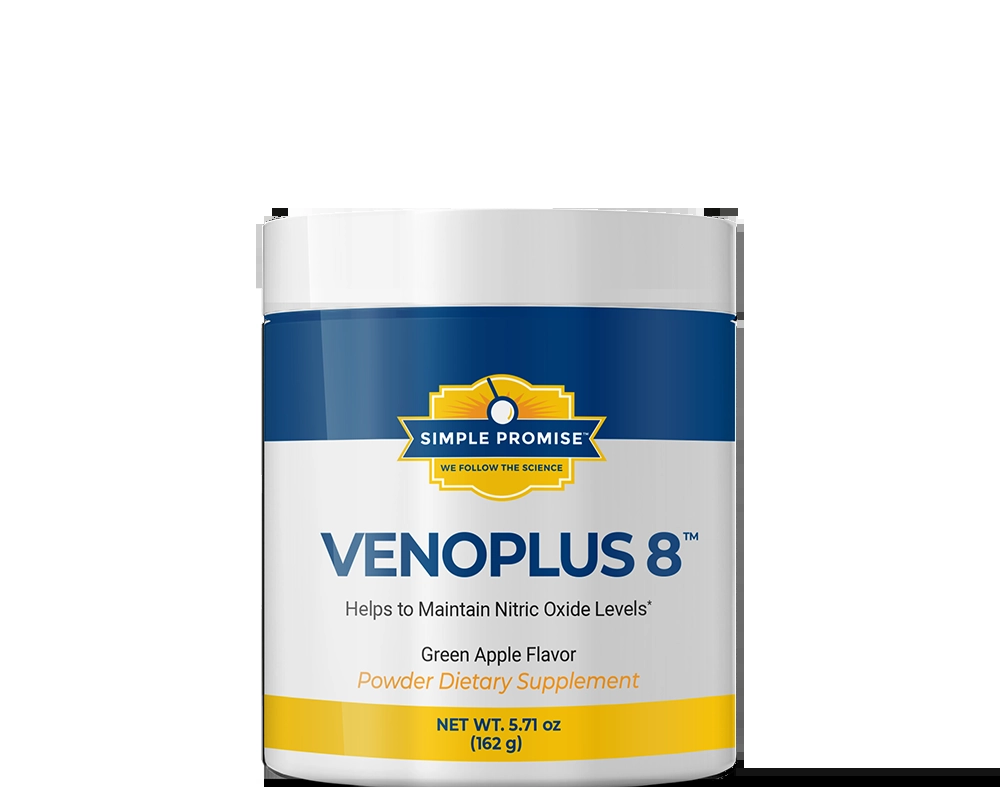
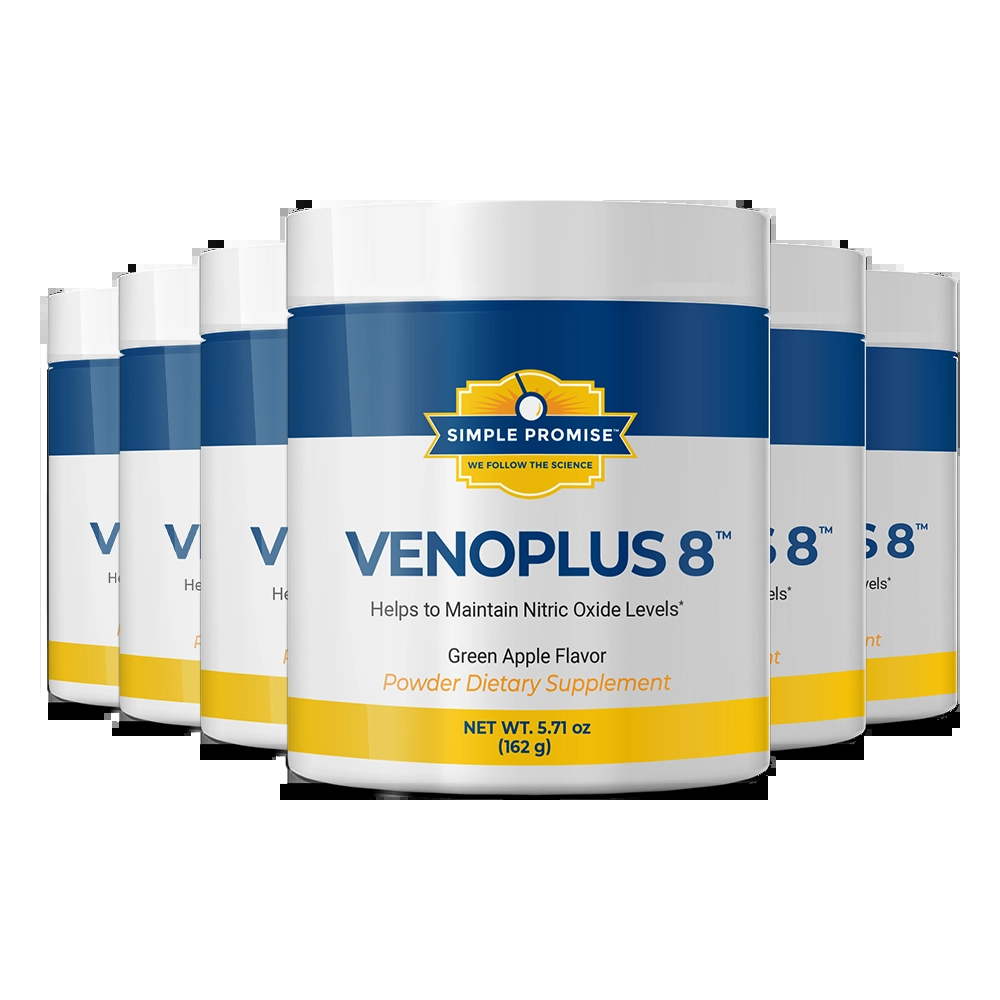
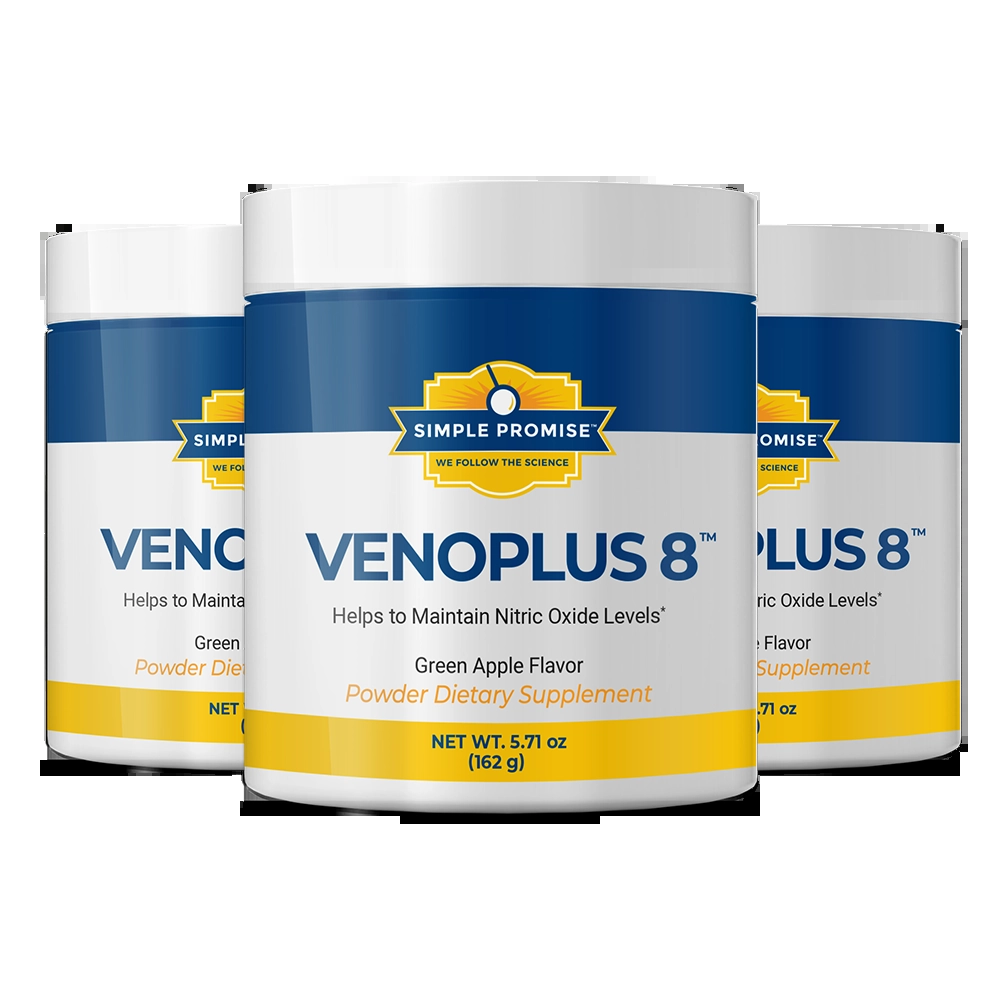
A once-a-morning powder built around three branded, research-backed ingredients — MenaQ7® vitamin K2, RedNite® beetroot and Pomella® pomegranate — designed to help your body produce more nitric oxide, support healthy blood pressure and keep your arteries flexible as you age.
VenoPlus 8™ is a daily powdered supplement from Simple Promise, a direct-to-consumer supplement company based in Camas, Washington, trading since 2019. Each jar holds 162 grams of green-apple flavoured powder — exactly thirty 5.4-gram scoops. You stir one scoop into about ten ounces of cold water or a smoothie each morning, preferably with breakfast, and that is the whole routine: no capsules, no pills, nothing to swallow.
The formula is built on a single idea: nitric oxide. Nitric oxide is the molecule that tells your arteries to relax and open wide, which supports healthy blood flow and healthy blood pressure. Your body's natural nitric oxide production declines with age — and the vendor's pitch is that restoring it is the key to keeping arteries flexible, blood pressure in a healthy range, and energy levels up. The powder format is deliberate: the vendor says the amounts of amino acids such as L-citrulline that its formula aims for simply would not fit inside capsules, so the nutrients come as a drink instead.
Behind the nitric oxide story sits the vendor's central claim about a substance it calls "plaque protein". According to the sales presentation, this protein rises with age and acts like a glue that hardens cholesterol build-up onto artery walls, stiffening and narrowing them. The formula's lead ingredient, MenaQ7®, is presented as the answer — the vendor says it cuts plaque protein levels by 93% and cuts heart attack risk by half. Be clear about what that is: it is the vendor's framing of the research, not an established medical mechanism. There is no whole-product clinical trial of VenoPlus 8 itself, and the studies the vendor cites were done on individual ingredients, not on this ten-ingredient blend. This page reports the vendor's claims as vendor claims, and separates them from what independent research actually shows — which, for the three branded ingredients, is genuinely interesting, as the ingredient section below explains.
One more thing to know before you read on: Simple Promise publishes no Supplement Facts panel for VenoPlus 8 anywhere — not on the sales page, not on the label photographs, not in any public document we could find. That means nobody outside the company knows how many milligrams of any ingredient are in a scoop. The formula's whole advantage is supposed to be dose capacity — a powder can carry gram-scale amino acids that capsules cannot — yet the doses are unpublished, and the 5.4-gram scoop sets a hard ceiling that makes research-level amounts of all ten ingredients arithmetically impossible. That gap is the single most important fact about this product, and this page flags it wherever it matters rather than hiding it.
VenoPlus 8 is not a drug and it does not work overnight. It works nutritionally, in five overlapping ways — each one tied to specific ingredients in the formula, and each one honest about what the research does and does not prove.
The fastest route in the formula runs through RedNite®, a standardised beetroot concentrate. Dietary nitrate is reduced to nitrite by bacteria on your tongue, then to nitric oxide in the blood — a pathway that does not depend on your liver. Nitric oxide signals the smooth muscle in artery walls to relax, which supports healthy blood flow and healthy blood pressure. A 2024 meta-analysis of eleven randomised trials in adults with hypertension found beetroot juice lowered clinical systolic pressure by about 5.3 mmHg against placebo, with no significant effect on diastolic or 24-hour measures and low certainty of evidence. Those trials delivered 200 to 800 mg of nitrate a day; VenoPlus 8 does not state its nitrate content, so the vendor's much larger claim — a 12/8 mmHg drop — is a vendor claim, not something the published research on beetroot supports at face value. What is solid is the mechanism itself: nitrate to nitric oxide is real physiology, and beetroot is the best-known dietary source of it.
The lead ingredient is MenaQ7®, a branded vitamin K2 in the MK-7 form, and it carries the strongest single trial in the jar. In a three-year, double-blind, randomised, placebo-controlled trial published in Thrombosis and Haemostasis (2015), 244 healthy postmenopausal women received 180 micrograms of MenaQ7 daily or a placebo; carotid-femoral pulse wave velocity — the standard measure of arterial stiffness — fell significantly in the supplemented group, most clearly in the women whose arteries were stiffest at baseline. The mechanism is credible: vitamin K2 activates matrix Gla-protein, which helps direct calcium into bone rather than into vessel walls. Three years is also the honest timescale — this is slow, structural support, not a quick fix. The catch, again, is dose: Simple Promise does not publish how much MenaQ7 is in a scoop, so nobody can tell you whether it reaches the 180 micrograms the trial used.
The third branded ingredient is Pomella®, a punicalagin-standardised pomegranate extract made with a patented extraction process. The vendor says its urolithins begin working within 30 minutes and that it reduces arterial thickness by 30% — vendor figures, not independently confirmed for this product. What independent research does show is encouraging in a more modest register: a 2024 meta-analysis of 22 randomised trials found pomegranate consumption reduced systolic blood pressure by about 7.9 mmHg and diastolic by 3.2 mmHg, with very high heterogeneity between studies and a larger effect in people who started above 130 mmHg. The caveat the authors flag themselves is enormous: most of those trials used pomegranate juice in glass-sized quantities rather than a concentrated extract, which is a real gap between the research and the jar. Pomella is still a legitimate, standardised extract — you can look it up by name in the literature, which you cannot do with a generic "pomegranate powder".
Your body makes nitric oxide from the amino acid L-arginine, using an enzyme called nitric oxide synthase. The problem is that most oral arginine is destroyed by first-pass liver metabolism before it ever reaches the bloodstream. L-citrulline survives that first pass far better and raises plasma arginine more reliably — which is why serious formulas pair the two, and VenoPlus 8 does exactly that, alongside L-taurine. A 2025 meta-analysis of fifteen randomised trials in middle-aged and older adults found L-citrulline lowered systolic pressure by about 4.0 mmHg and diastolic by 2.5 mmHg, with the citrulline-plus-arginine combination performing best. But here the dose question is at its sharpest: those trials used three to six grams of citrulline a day, and the entire VenoPlus 8 scoop is 5.4 grams — flavouring included. Three grams of citrulline would be a serious dose and would fit, just, inside the scoop. Five hundred milligrams would also fit, alongside a great deal more flavouring. The two products would look identical in marketing copy. Pairing citrulline with arginine is the correct formulation decision; whether this jar pairs them at useful amounts is unknowable from the label.
The remaining ingredients — vitamin C, magnesium ascorbate, hesperidin, grape seed polyphenols and L-taurine — form the formula's supporting cast, and they are sensible, unglamorous support rather than padding. Vitamin C protects tetrahydrobiopterin, the cofactor nitric oxide synthase needs to work properly, and helps combat oxidative stress in blood vessel walls. Grape seed extract is quietly one of the better-supported entries: a 2022 systematic review found it improved flow-mediated dilation and reduced blood pressure across randomised trials, and it is the single active ingredient the best-known competitor in this category builds its whole formula around, at a published 150 mg. Hesperidin, the citrus flavonoid behind most of the vascular research on orange juice, supports endothelial function. Magnesium is a genuine shortfall nutrient with an established role in normal heart rhythm. None of these is doing the heavy lifting alone; together they protect the nitric oxide the first four steps work to create, because nitric oxide is quickly destroyed by oxidative stress if it is not defended. The habit matters as much as the chemistry: nitric oxide support is cumulative, and endothelial change is a matter of weeks, not days — which is why the vendor's own guidance is one scoop, every morning, without fail.
One simple morning drink covering the main ways circulation ages — from nitric oxide production to arterial flexibility. Every benefit below is written in "supports / helps / promotes" language, because that is what a supplement can honestly claim.
This is the benefit most buyers come for, and the one with the most research behind it — at the ingredient level. Beetroot nitrate, pomegranate, grape seed extract and L-citrulline each have randomised trials or meta-analyses showing modest reductions in systolic blood pressure, typically in the range of 4 to 8 mmHg. VenoPlus 8 combines all four in one scoop, which is a reasonable formulation idea. What it cannot honestly promise is the vendor's headline figure of a 12/8 mmHg drop, because that number comes from the vendor's own presentation of RedNite, not from a trial of this product, and the doses in the scoop are unpublished. If you own a home blood pressure cuff, the honest way to judge it is a week of baseline readings before your first scoop and another week at week eight — same arm, same time of day, seated five minutes first, averaged over the week rather than read once.
The vendor's story is that its "plaque protein" mechanism keeps cholesterol soft and sludge-like so the body can flush it out, instead of letting it harden onto artery walls. That framing is the vendor's own; the underlying idea it borrows from is real enough — arterial health is about the condition of the vessel wall as much as the cholesterol number itself. MenaQ7's role in activating matrix Gla-protein, which helps keep calcium in bone rather than in vessel walls, is the most credible part of this story and has a three-year randomised trial behind it. Pomegranate and grape seed polyphenols add antioxidant support for the vessel lining. But be clear: VenoPlus 8 is not a cholesterol drug, it is not a statin, and it does not replace one. If your doctor has prescribed cholesterol medication, this powder is at most an addition to that plan — never a substitute for it.
Stiff arteries are the slow, silent part of cardiovascular ageing: they raise blood pressure, make the heart work harder, and reduce the cushioning that healthy vessels provide with every heartbeat. The MenaQ7 trial is the strongest evidence in this jar — 244 women, three years, a significant reduction in carotid-femoral pulse wave velocity, the standard index of arterial stiffness. Pomella's pomegranate extract is presented by the vendor as reducing arterial thickness by 30%, a figure that comes from the vendor's materials rather than an independent trial of this product, though pomegranate meta-analyses do show blood pressure benefits. Flexibility is also the benefit that takes longest: the trial that proved it ran for three years, so anyone expecting supple arteries in a fortnight is expecting the wrong thing from the right ingredient.
Everything in the formula points at nitric oxide, and it attacks the problem from two directions at once: supplying the raw material (dietary nitrate from RedNite beetroot, plus L-citrulline and L-arginine as the direct precursors) and protecting the enzyme that makes it (vitamin C guarding tetrahydrobiopterin, magnesium supporting the pathway). Hesperidin is included specifically because research links it to nitric oxide release. This dual approach — make more, waste less — is the most thoughtful part of the formulation. The vendor even sells a separate bonus guide for testing your nitric oxide levels at home, which is a sensible idea in principle: if the product works by raising nitric oxide, a saliva test strip is the cheapest way to check. Just remember that a test strip measures a proxy, not your arteries, and that the vendor's "25 times the ability to boost nitric oxide" line is marketing arithmetic, not a measured result.
Steadier daily energy without a stimulant curve is the most commonly reported change across nitric oxide products — and also the hardest to separate from expectation, because there is no caffeine in this formula and no stimulant lift to feel. The mechanism is plausible rather than proven: better blood flow means oxygen and nutrients reach muscles and brain more efficiently, and the vendor says customers notice a dramatic energy boost within 30 minutes of the first scoop. Treat the 30-minute claim with the scepticism it deserves — it is a sales-page line, not a trial result — and judge energy over weeks instead. In independent reviews of this product, steadier energy was reported by just over half of surveyed users over 90 days, which is consistent with a real but modest effect plus a fair amount of placebo. Energy is also the easiest benefit to imagine, so write down on day one what specifically bothers you, and compare against that note at week eight.
When blood flows more freely, the effects people notice first are often the small, physical ones: warmer hands and feet, walking further before feeling it, stairs registering less. Warmer extremities are a small, oddly consistent report across nitric oxide products, and they fit the vasodilation mechanism — relaxed vessels deliver more warm blood to the fingers and toes. Better exercise tolerance is the earliest change that is actually measurable: if you walk a set route every day, time it before you start and again at week six. The vendor's sales page goes further, promising you will leap out of bed with fewer aches, garden for hours and hike your favourite trails — that is sales copy, not a promise the ingredients can guarantee. What the formula can reasonably support is normal circulation and everyday cardiovascular wellness in people whose numbers are already in a healthy range, with exercise, sleep and sodium reduction doing the heavier work alongside it.
Your brain is the most blood-hungry organ you own, using roughly a fifth of your oxygen despite being a fraction of your weight — so anything that supports healthy blood flow has a plausible claim on clearer thinking. The vendor promises a sharp mind and a memory like a steel trap, and credits the formula with cutting brain fog. The honest version is more modest: nitric oxide supports the blood flow the brain depends on, L-taurine has a long research history in cardiovascular contexts, and magnesium supports normal nerve function. None of that is a memory treatment, and there is no trial showing this product improves cognition. If brain fog is new, worsening, or accompanied by other symptoms, that is a conversation for your doctor, not a supplement. What a daily circulation formula can reasonably offer is support for the blood flow that clear thinking depends on — nothing more dramatic than that, and nothing less useful either.
Magnesium is the quiet workhorse of this formula, and it is the ingredient most adults are actually short of: US intake surveys consistently find a large share of adults below the recommended amount. Magnesium has an established role in muscle and nerve function and in maintaining a normal heart rhythm, which is why the vendor includes magnesium ascorbate — a form that also contributes vitamin C. Hesperidin and the grape seed polyphenols add support for the endothelium, the delicate inner lining of blood vessels, which is where healthy circulation actually happens. This is not a treatment for arrhythmia or any heart condition, and it must never be used as one — palpitations, chest pain, breathlessness on exertion or swelling in both legs are reasons to see a doctor this week, not reasons to buy a supplement. But for a healthy adult who wants to support the everyday comfort of a heart that has to beat a hundred thousand times a day, the magnesium and flavonoid content is a reasonable, well-chosen foundation.
Every scoop contains ten named nutrients. What it does not contain, anywhere the public can see it, is a single milligram amount. Simple Promise publishes no Supplement Facts panel for VenoPlus 8, so every dose below is honestly marked "not published" — nothing here is invented.
The branded MK-7 that carries the strongest trial in the jar. Knapen and colleagues gave 180 micrograms of MenaQ7 daily to 244 healthy postmenopausal women for three years and measured a significant reduction in carotid-femoral pulse wave velocity, the standard index of arterial stiffness (Thrombosis and Haemostasis, 2015). The mechanism is vitamin K2's role in activating matrix Gla-protein, which helps keep calcium in bone rather than in vessel walls. Simple Promise does not publish how much MenaQ7 is in a scoop, so we cannot tell you whether it reaches the 180 micrograms the trial used. This is also the ingredient that creates the product's most serious drug interaction: warfarin works on the vitamin K pathway, so anyone taking it needs their prescriber's input before ordering.
A standardised beetroot concentrate, the vehicle for dietary nitrate. Nitrate is reduced to nitrite by bacteria on the tongue and then to nitric oxide in the body, which is the pathway the whole product is built on. A 2024 meta-analysis of 11 randomised trials in 349 adults with hypertension found beetroot juice lowered clinical systolic blood pressure by about 5 mmHg against placebo, with no effect on diastolic or 24-hour measures and low certainty of evidence. Those trials delivered 200 to 800 mg of nitrate per day; no nitrate content is disclosed here. The vendor claims a 12/8 mmHg drop and says RedNite is extracted within 24 hours of harvesting for 10 times the heart-protecting antioxidants — vendor claims, not trial results. One harmless quirk: beetroot can turn urine pink or red, which is startling the first time and completely benign.
A punicalagin-standardised pomegranate extract made with a patented extraction process. A 2024 meta-analysis of 22 randomised trials found pomegranate consumption reduced systolic blood pressure by roughly 8 mmHg and diastolic by 3 mmHg, with the caveat of very high heterogeneity between studies and a larger effect in people who started above 130 mmHg. Most of those trials used juice rather than a concentrated extract, which is a real gap between the research and the jar. The vendor says Pomella's urolithins kick in just 30 minutes after you take it and reduce arterial thickness by 30% — vendor figures. What makes Pomella worth having is traceability: it is a branded, standardised material you can search in PubMed under its own name, which you cannot do with a generic "pomegranate powder".
A citrus flavonoid from the peels of oranges, the compound behind most of the vascular research on orange juice. Human work points to effects on endothelial function and inflammatory markers rather than anything dramatic, and the vendor includes it specifically for its ability to support nitric oxide release and help balance blood pressure. It is a sensible inclusion in a circulation formula at an undisclosed amount — reasonable, well-chosen, and impossible to evaluate for dose. The vendor sources it, by its own account, from oranges grown off the coast of the Comoros Islands; the origin story is charming and irrelevant to whether the amount in the scoop is enough to matter, which is the question the unpublished dose leaves unanswered.
Proanthocyanidin-rich extract from the seeds of a little-known grape grown in the vineyards of Greece, per the vendor's account. A 2022 systematic review and meta-analysis found grape seed extract improved flow-mediated dilation and reduced blood pressure across randomised controlled trials (Pharmacological Research) — quietly one of the better-supported entries in this formula. It is also the single active ingredient that the best-known competitor in this category, SuperBeets Heart Chews, builds its whole formula around, at a published 150 mg. That comparison is instructive: a competitor tells you its dose, and this product does not. The polyphenols are described by the vendor as warriors standing guard inside the arteries against plaque protein — colourful language for antioxidant support of the vessel lining.
The recognised antioxidant that supports endothelial function partly by protecting tetrahydrobiopterin, the cofactor nitric oxide synthase needs to work properly. The vendor's version is a specialised form of vitamin C packed with antioxidants that course through the blood vessels to combat oxidative stress and remove free radicals that damage arteries — which, the vendor says, prevents plaque protein from coming back. Vitamin C is also the one ingredient on this label whose general benefit does not depend on hitting a precise dose: even a modest amount supports the antioxidant network. It is paired in the formula with magnesium ascorbate, a buffered form of vitamin C that is gentler on the stomach than ascorbic acid alone.
The fourth additional nutrient in the vendor's own telling, found in ripe kiwis from the volcanic soil of New Zealand — the vendor's origin story, reported as such. What matters is the chemistry, not the kiwis: magnesium ascorbate delivers magnesium in a buffered vitamin C form, and countless clinical studies show magnesium helps regulate heartbeat by turning on the body's internal production of nitric oxide. Magnesium is a genuine shortfall nutrient — US intake surveys consistently find a large share of adults below the recommended amount — with an established role in muscle and nerve function and normal heart rhythm. The form matters a great deal for both absorption and bowel tolerance, and Simple Promise does not say which form it uses beyond the name, or how much. People with kidney disease should clear magnesium-containing supplements with their nephrologist.
The better of the two nitric-oxide amino acids, because it bypasses the first-pass liver metabolism that destroys most oral arginine and therefore raises plasma arginine more reliably than arginine itself. A 2025 meta-analysis of 15 randomised trials in middle-aged and older adults found L-citrulline and watermelon intake lowered systolic blood pressure by 4.0 mmHg and diastolic by 2.5 mmHg (Clinical Nutrition ESPEN). The trials it pooled typically used 3 to 6 grams a day — more than the entire 5.4-gram scoop, which is why the undisclosed dose matters most here. Three grams would be a serious dose and would fit, just, inside the scoop. Five hundred milligrams would also fit, alongside a great deal more flavouring. The formula's entire structural advantage is dose capacity; the unpublished dose is the one omission that matters.
The direct substrate for nitric oxide synthase, and the reason the citrulline is beside it. Your body converts arginine into nitric oxide, so supplying it directly is the most literal way to feed the pathway — but most oral arginine is broken down by the liver before it reaches the bloodstream, which is exactly why it is paired with citrulline here. The same 2025 meta-analysis found the citrulline-plus-arginine combination outperformed either alone, dropping systolic pressure by 10.4 mmHg in its subgroup analysis. Pairing them is the correct formulation decision; whether this jar pairs them at useful amounts is unknowable from the label. One caution: do not stack this with a separate beet powder or a citrulline pre-workout. You are not doubling a benefit, you are doubling a blood-pressure effect you cannot measure.
An amino acid with antioxidant activity and a long, mostly Japanese, research history in cardiovascular contexts. The vendor lists it among the three amino acids most people do not get enough of, found in fish like salmon, seaweed from clean oceans and fruit — and says it is nearly impossible to get the correct and sufficient amounts of all of these nutrients from regular food without a registered dietitian watching every bite. That is a fair point about modern diets generally, and it is also the kind of claim that is easy to make when no amounts are published. Included here as a supporting antioxidant rather than as a lead ingredient, L-taurine rounds out the amino-acid trio and contributes to the formula's antioxidant defence of the nitric oxide pathway.
Why "VenoPlus 8" when the formula lists ten nutrients? The vendor never explains it, and independent reviewers have flagged the same mismatch — the product is called VenoPlus 8 while listing ten ingredients. The most likely explanation is branding history (an earlier eight-ingredient version), but that is a guess, not a fact the vendor confirms. What matters for buyers is the list above: ten named nutrients, three of them branded and standardised, none of them with a published dose. If you are pregnant, nursing, under 18, or taking medication — especially warfarin or nitrate medication for angina — consult your physician before use.
VenoPlus 8 was designed for adults who can feel their circulation changing — and who would rather support it nutritionally than simply accept it. You may recognise yourself in one of these groups:
If you have high blood pressure, high cholesterol, or heart issues that run in your family, this is the audience the product was created for. The three branded ingredients each carry real randomised research, and the powder format suits people who want nitric oxide support without swallowing more capsules. But keep the hierarchy straight: exercise, sleep, sodium reduction and your doctor's advice are the interventions with the strongest evidence for endothelial function, and none of them costs $59. A scoop is a reasonable addition to those — and a poor substitute for them.
The vendor's own reason for choosing a powder is that older adults are already taking an increasing number of medications and vitamins, and choking down dozens of horse pills a day is tiresome. If you already drink something at breakfast, stirring a scoop into water or a smoothie is a habit you will genuinely keep — and adherence is the benefit nobody counts and everyone should. A supplement you stop taking by week three does nothing at any dose. The green-apple flavour is sweet but not too sweet, by the vendor's account, though some users report the artificial taste wears thin by week three.
If you have tried capsule-based nitric oxide products and suspected the dose was the problem, you were probably right: a capsule holds 500 to 800 milligrams, while citrulline trials use three to six grams a day. A 5.4-gram powder scoop is the only format that can physically carry those amounts — which is precisely why the unpublished doses are so frustrating. If dose transparency matters to you, ask the company for the Supplement Facts panel before you order; the phone number is 1-800-259-9522. A company that can answer that question in one call is a company worth buying from.
The single jar at $59 with free shipping and a 365-day guarantee makes this a reasonable one-jar experiment: you can test for a month rather than commit to a bundle, and the guarantee gives you a full year to decide. That is the sensible way to buy it. The six-jar package at $39 a jar is the better per-jar price, but it is not a reasonable first purchase of a formula whose doses you cannot verify — start with one jar, take it with breakfast rather than on an empty stomach, and if you own a blood pressure cuff, take a week of baseline readings before your first scoop and another at week eight.
An honest boundary: VenoPlus 8 is a nutritional supplement, not a treatment. Two interactions deserve a phone call before you order: nitrate medication for angina (nitroglycerin, isosorbide mononitrate or dinitrate) — adding a product designed to raise nitric oxide can cause a serious drop in blood pressure — and warfarin, because vitamin K2 is the lead ingredient and warfarin works on that pathway. Tell your doctor if you take blood pressure medication, and never stop a prescription because a supplement arrived. The vendor's own sales page carries a testimonial from a customer who says he stopped taking his blood pressure medication — do not do that. Stopping prescribed heart or blood pressure medication without your doctor's say-so is dangerous, and no testimonial changes that. If you are under 18, pregnant or breastfeeding, or have kidney disease, this product is not for you without medical clearance.
Nutritional support works on the body's timetable, not a stopwatch. Individual experiences vary — this is a realistic map of the first six months, drawn from the vendor's own guidance and independent reviews of the product.
Expect nothing dramatic except possibly pink urine from the beetroot and a mild headache in the first few days — both normal, both pass, and the pink urine is harmless. The vendor says the ingredients can work in as quickly as 30 minutes and promises an immediate energy boost; treat that as sales copy. The real work of week one is building the habit: one scoop, every morning, with breakfast, stirred or shaken properly — under-dilution is behind most of the digestive grumbling in public feedback.
By the end of the first jar, the formula has had a month of steady supply. If anything shifts early, it is usually perceived energy and exercise tolerance — also the easiest thing to imagine, so compare against the note you wrote on day one about what specifically bothered you. Some people report warmer hands and feet by now. Others notice nothing at all. Both are normal. This is groundwork, not the finish line: endothelial change is a matter of weeks, and the vendor itself says the real transformation comes around the six-month mark.
Two months in, you have enough data to judge. If you own a home blood pressure cuff, this is the useful moment: same arm, same time of day, seated five minutes first, averaged over a week rather than read once, compared against your pre-supplement baseline week. Walking a set route and timing it is the other honest test — exercise tolerance is the earliest change that is actually measurable. If your numbers have not moved and you feel nothing different, say so plainly to yourself: the 365-day guarantee exists precisely for that outcome.
Ninety days is the fair test most circulation routines ask for — and the reason the 3-jar package exists. By now the amino acids and beetroot nitrate have had three months of daily supply, and the MenaQ7 has had three months to build up in arterial tissue (the trial that proved it ran for three years, so three months is still early for that ingredient). Compare like with like: your morning energy, your walking distance, your home cuff average. If you feel meaningfully better supported, you have your answer; if not, nine months of your guarantee still remain.
With the routine established, the focus shifts to maintenance — the daily protection of vessels that cannot simply be repaired once lost. Pair the scoop with the habits that multiply its value: aerobic exercise, sleep, sodium reduction, and your regular check-ups booked and kept. Do not stack this with a separate beet powder or a citrulline pre-workout; you would be doubling a blood-pressure effect you cannot measure. And keep taking any prescribed medication exactly as your doctor directed — this powder supports your routine, it does not replace any part of it.
Six months is the point the vendor calls the complete transformation — "a brand-new person who is decades younger", in the sales letter's words — and it is also the point where the 6-jar package runs out. Judge it on your own evidence: your cuff averages, your walking times, your energy notes. If you are not satisfied, the guarantee still has six full months left, so there is no rush to decide. Contact support, and claim your refund if the product has not earned its place in your morning.
Most people weighing up VenoPlus 8 are really choosing between four paths. Here is an honest look at what each one does — and doesn't — do.
A daily powder approach. One 5.4 g scoop supplies three branded, standardised ingredients — MenaQ7, RedNite and Pomella — plus seven supporting nutrients, targeting nitric oxide production, arterial flexibility and blood pressure support from several directions at once. It does not treat or cure any condition, and its doses are unpublished, which is its real weakness. From $39 a jar on the 6-jar package, with free shipping and a 365-day money-back guarantee — the longest guarantee in this category.
Convenient and familiar, but physically limited: a capsule holds 500 to 800 milligrams, while the citrulline trials used three to six grams a day. Capsule formulas in this category almost always under-dose the amino acids, and many hide behind proprietary blends that disclose even less than VenoPlus 8 does. If you want gram-scale citrulline, only a powder can carry it — which is the honest case for this product's format, and the reason its unpublished doses are so frustrating.
The cheapest route, and not a bad one: beetroot juice is the ingredient with the most direct trial evidence, and a daily glass delivers real dietary nitrate. Pomegranate juice, leafy greens, citrus and oily fish cover much of the rest of the formula's logic for grocery money. What food cannot easily give you is MenaQ7 at a trial-level dose — you would need nearly five bowls of natto-style fermented foods a day, by the vendor's own telling — or a standardised Pomella extract. Food first is sound advice; this powder is for people who want the branded extracts on top of it.
The simplest option, and for a while it feels free. But the forces acting on ageing arteries — declining nitric oxide production, oxidative stress, nutrient gaps in a modern diet — do not pause. Arterial stiffness builds over years and cannot simply be reversed later. Supporting your circulation early, while your vessels are still healthy, is the one option that cannot be bought back afterwards — though the uncomfortable context is that the interventions with the strongest evidence are aerobic exercise, sleep and sodium reduction, and none of them costs $59.
Order through the official checkout to qualify for the guarantee and bonuses. Every package is covered for 365 days, with FREE shipping on every order. Prices below are the live prices on the official sales page at the time of writing (November 2026) — always confirm the final price at checkout.
⚠ High demand — the vendor says only 250 jars are set aside at these prices today, and discounted pricing is not guaranteed to last. (That "250 jars" figure is the vendor's own scarcity claim and cannot be independently verified.)
Three digital guides worth $127 in total, included free with every 3-jar and 6-jar order. The single-jar package does not include them.
How to test your nitric oxide levels from home, plus ways to boost your nitrate intake to complement what VenoPlus 8 offers. Regular $39 — FREE today
How to use the calibrated heat of a sauna to improve blood flow, lower blood pressure, and help stiff arteries relax. Regular $39 — FREE today
Step-by-step breathing techniques designed to reduce stress, control blood pressure and support heart health. Regular $49 — FREE today
Try VenoPlus 8 for a full twelve months. If you don't feel the support for your heart and circulation — steadier energy, easier movement, better blood pressure and cholesterol numbers — simply contact the English-speaking customer service team at 1-800-259-9522 and you'll get a quick, no-hassle refund of every penny you paid. No questions. No hoops. No weird fine print. That is the vendor's own promise, and at 365 days it is the longest guarantee in this category — twice as long as most competitors offer.
Two honest notes about the guarantee. First, the refund terms are inconsistent between the vendor's own pages: the guarantee box says to contact the team, while the FAQ says to return your empty jars — so confirm the exact return steps with support when you order, and keep your order confirmation. Second, slow refund processing is the most repeated complaint in public feedback about this product, with some buyers reporting it took weeks and follow-up emails — so budget some patience if you claim. The guarantee is real and it is generous; the administration of it has drawn complaints, and you should know that before you buy.
TRY VenoPlus 8 RISK-FREE FOR 365 DAYS →VenoPlus 8 is a green-apple flavoured heart-health powder from Simple Promise (Camas, Washington). Each jar holds 162 grams — thirty 5.4-gram scoops — built around three branded ingredients (MenaQ7® vitamin K2, RedNite® beetroot and Pomella® pomegranate) plus seven supporting nutrients, designed to support nitric oxide levels, healthy blood pressure and arterial flexibility. It is a dietary supplement, not a drug, and it is sold only through the official website.
Mix one 5.4-gram scoop into about ten ounces of cold water or a smoothie each morning, preferably with breakfast. Stir or shake properly — under-dilution is behind most of the digestive grumbling in public feedback — and take it at the same time every day. It does not clump, it tastes of green apple, and it is sweet but not too sweet, by the vendor's account. There is no caffeine in it, so evening dosing is possible, but the people who stay consistent are almost always the ones who attach it to a meal they already eat.
The vendor says the ingredients can work in as quickly as 30 minutes and promises an energy boost after the first scoop — treat that as sales copy, not a trial result. Realistically, expect nothing in week one except possibly pink urine and a mild headache, both of which pass. Weeks 2–4 are when perceived energy and exercise tolerance may shift; weeks 4–12 are where the circulation research would predict measurable change. The vendor says the real transformation comes around the six-month mark, which is why the 6-jar package and the 365-day guarantee exist.
Ten ingredients: MenaQ7® (vitamin K2 as MK-7), RedNite® (beetroot extract), Pomella® (pomegranate extract), hesperidin, grape seed polyphenols, vitamin C, magnesium ascorbate, L-citrulline, L-arginine and L-taurine. The second half of the question is the problem: Simple Promise publishes no Supplement Facts panel anywhere we could find, so no dose can be verified for any of the ten. That matters more here than elsewhere, because the whole advantage of a 5.4-gram powder over a capsule is dose capacity — citrulline trials use three to six grams a day, and the entire scoop is 5.4 grams including flavouring. We have invented no doses on this page, and you should ask the company for the panel before ordering if dose transparency matters to you.
Good question — and one the vendor never answers. The product is called VenoPlus 8 while its own sales page and FAQ list ten nutrients, and independent reviewers have flagged the same mismatch. The most likely explanation is branding history — an earlier eight-ingredient version of the formula — but that is a guess, not something the vendor confirms. It does not change what is in the jar, but it is a useful reminder to read the ingredient list rather than the name.
For most healthy adults this is a well-tolerated category: nitric-oxide precursors, beetroot, pomegranate and magnesium are ordinary dietary components, and the complaints in public feedback are overwhelmingly mild and digestive. Possible effects include harmlessly pink or red urine from the beetroot, mild stomach upset or loose stools (most often from magnesium or from under-diluting the scoop), headache in the first few days consistent with vasodilation, and light-headedness on standing quickly, particularly in people already on blood pressure medication. The product is made in a cGMP-certified facility and is free from fillers, soy, dairy and heavy metals by the vendor's account. If you are pregnant, nursing, under 18, or have a medical condition, consult your physician first.
Talk to your prescriber first — this is the most important safety question on this page. Vitamin K2 is the lead ingredient, and warfarin works by interfering with vitamin K-dependent clotting factors, so supplying vitamin K2 is the entire premise of MenaQ7. Anyone on warfarin needs their prescriber's input and almost certainly INR monitoring. Apixaban and rivaroxaban do not work through vitamin K, so the concern there is smaller, but still mention any new supplement to your doctor. Do not start this product while on warfarin without that conversation.
No — not without cardiologist clearance. If you take nitroglycerin, isosorbide mononitrate or dinitrate for angina, adding a product designed to raise nitric oxide can cause a serious drop in blood pressure. That is the same mechanism behind the standard warning against combining nitrates with prescription erectile medication — a real pharmacological interaction, not a legal formality. Get clearance first, and tell your doctor if you take blood pressure medication generally, keeping home readings for the first few weeks.
No — never. The vendor's sales page carries a testimonial from a customer who says he stopped taking his blood pressure medication after using the product. Do not do that. Stopping prescribed heart or blood pressure medication without your doctor's say-so is dangerous, and no testimonial changes that. VenoPlus 8 is a nutritional supplement, not a replacement for prescribed medicine. If your readings improve, that is a conversation to have with your doctor about your treatment plan — it is never a reason to stop a prescription on your own.
No — and no dietary supplement is. The FDA does not approve dietary supplements the way it approves drugs, so any supplement claiming to be "FDA approved" is misrepresenting the law. What the vendor does claim is that VenoPlus 8 is manufactured in a cGMP-certified facility and has passed rigorous testing for safety. Some review sites carry an "FDA Registered" badge next to this product; facility registration is a different thing from product approval, and this page makes no FDA claim of any kind. The product carries the standard FDA disclaimer: these statements have not been evaluated by the Food and Drug Administration, and the product is not intended to diagnose, treat, cure or prevent any disease.
Only through the official website — it is not available at Walmart, Target or any grocery store, and it is not sold on Amazon. Buying through the official checkout is what qualifies you for the 365-day guarantee and the free bonuses, and it is the only way to be sure you receive genuine stock. Listings on marketplaces or lookalike domains are offered by third-party sellers and are not covered by the guarantee, so use the official link on this page.
No. Every VenoPlus 8 order is a one-time payment. There is no subscription, no auto-ship programme and no recurring charge of any kind — this was verified at the checkout by an independent review. If you want more jars later, you simply place a new order. What you see at checkout is exactly what you pay. (The vendor does run an exit-intent offer on the sales page, so the price you see on a return visit may differ — confirm the final price at checkout before ordering.)
One jar is $59, three jars are $147 ($49 each) and six jars are $234 ($39 each), against a $99-per-jar list price — savings of $40, $150 and $360 respectively. Shipping is free and fast on every order, including single jars, and there is no subscription or auto-billing. Each jar holds 162 grams, which is thirty 5.4-gram scoops. The crossed-out $99 on the sales page is standard anchor pricing — $59 is the real single-jar price. Some review sites quote a $69 single-jar price or a 60- or 90-day guarantee; both are superseded by the live official terms used on this page ($59 and 365 days).
Three digital guides, free with every 3-jar and 6-jar order (not with the single jar): a DIY Guide to Testing Your Nitric Oxide Levels ($39 value), a Thermal Therapy Guide on using sauna heat for heart health ($39 value), and a Breath Work Video on breathing techniques for heart health ($49 value) — $127 in total. They are complementary resources for buyers who commit to a multi-jar package, and they are yours to keep. The bonuses are digital, so there is nothing to ship and nothing extra to select at checkout.
Every order is fully covered by the vendor's ironclad 365-day money-back guarantee: try the product for up to a year, and if you are not thrilled with your progress, contact the English-speaking customer service team at 1-800-259-9522 for a quick, no-hassle refund of every penny you paid. Two honest notes: the vendor's own pages disagree on the return steps (the guarantee box says to contact the team, the FAQ says to return your empty jars), so confirm the exact steps with support when you order; and slow refund processing is the most repeated complaint in public feedback, with some buyers reporting it took weeks and follow-up emails.
The vendor describes the flavour as sweet but not too sweet, and one independent review flags that the powder may contain sugar, which may not be suitable for people with diabetes or high blood sugar. The sales page does not publish a full Supplement Facts panel, so the sugar content per scoop cannot be confirmed from the vendor's own materials. If you manage blood sugar, check the label on the jar when it arrives — or call the company at 1-800-259-9522 and ask for the nutrition panel before you order — and show the ingredient list to your doctor.
Beetroot juice is the single ingredient with the most direct trial evidence, and a daily glass is a cheap, effective way to get dietary nitrate. SuperBeets Heart Chews, the best-known competitor, builds its whole formula around grape seed extract at a published 150 mg dose. VenoPlus 8's case is breadth: it combines beetroot nitrate with MenaQ7 vitamin K2 (three-year randomised trial on arterial stiffness), Pomella pomegranate extract, and the citrulline-arginine amino-acid pair, in a powder format that can physically carry gram-scale amino acids. Its weakness, against both alternatives, is dose transparency: SuperBeets publishes its dose and VenoPlus 8 does not.
Simple Promise™, a direct-to-consumer supplement company operating out of Camas, Washington since 2019, selling through ClickBank. The sales presentation is fronted by "Jonathan Parker", described as a researcher at Simple Promise — the vendor's own footer states that his name has been changed for privacy, so treat the personal story (including the account of his wife's heart attack) as the vendor's marketing narrative rather than a verified biography. The company itself is real: a street address in Camas (3242 NE 3rd Avenue #1051, Camas, WA 98607), a working phone line (1-800-259-9522), and a product line sold since 2019. The presenter is a pen name; the company is not.
Support your heart with 10 nutrients — including MenaQ7®, RedNite® and Pomella® — for as little as $39 a jar, backed by a 365-day money-back guarantee and free shipping.
GET YOUR 61% DISCOUNT NOW →